Air source heat pumps
The standard choice for most homes in Tunbridge Wells. An outdoor unit takes heat from the air and feeds your radiators, underfloor heating and hot water.
Air sourceThe standard choice for most homes. An outdoor unit takes heat from the outside air and feeds your radiators, underfloor heating and hot water cylinder, with the grant deducted from your invoice.
Tell us about your property and an MCS-certified engineer will be in touch, usually the same working day.
An air source heat pump is a refrigeration cycle running backwards. It absorbs low-grade heat from the outside air, compresses the refrigerant to raise its temperature, then transfers that heat into your central heating water. Because it moves heat rather than creating it, it delivers roughly three to four units of heat for every unit of electricity it uses. A gas boiler, at best, gives you slightly under one.
It keeps working in cold weather. Output drops as the outside temperature falls, which is why correct sizing against your worst-case design day matters, but a properly specified unit will heat a house through a Kent winter without a backup boiler.
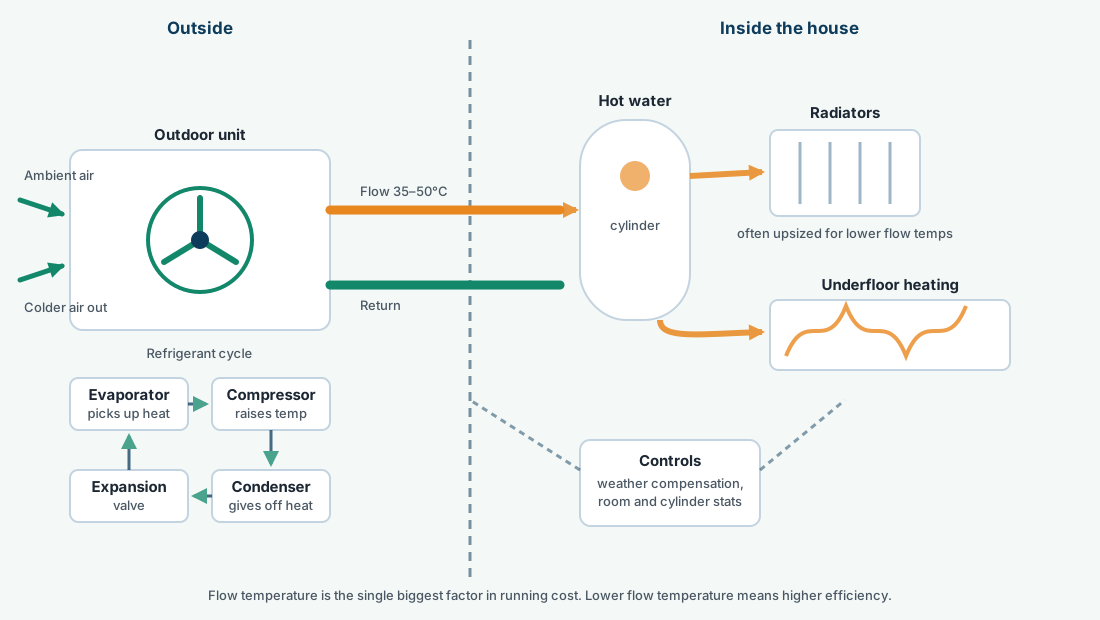
This is the part most quotes gloss over. A boiler runs at 70 to 80°C. A heat pump is most efficient at 35 to 45°C. The lower the flow temperature it can run at while still heating the house, the cheaper it is to run.
Getting there usually means upsizing some radiators, because a radiator emits far less heat at 45°C than at 75°C. In a typical Tunbridge Wells three-bed we might change four to six radiators and leave the rest. An installer who tells you no radiators need changing has either done a very careful calculation or none at all, and it is worth asking which.
Most domestic installations take three to five working days on site. A straightforward swap on a modern house with adequate radiators can be done in two. Larger period properties with significant pipework and emitter changes can run to a week or more. From first survey to commissioning, allow four to eight weeks including the grant process.
We install Daikin, Mitsubishi Electric, Vaillant, Samsung, NIBE, Grant and Worcester Bosch, and recommend on the basis of your design flow temperature, the noise position and the space available rather than on which manufacturer offers the best installer margin.
Typically £8,000 to £14,000 before grant for most houses, and £14,000 to £20,000 or more for large or period properties. With the Boiler Upgrade Scheme taking £7,500 off, most households pay a net figure between £1,500 and £6,500.
Yes. They keep producing heat well below freezing, though output and efficiency fall as the outside temperature drops. That is why we size the system against a design temperature for this area rather than an average, so it still meets the load on the coldest days of the year.
Usually not all of them. A heat pump runs at a lower flow temperature than a boiler, so some radiators need to be larger to emit the same heat. In a typical three-bed we replace four to six. The heat loss survey tells us exactly which, room by room.
In England most domestic installations are permitted development, and the rules were relaxed in May 2025: the one metre boundary rule was removed, the size limit rose to 1.5 cubic metres and detached homes can have two units. The installation still has to pass the MCS 020(a) noise assessment. Listed buildings always need consent, and conservation areas and Article 4 zones need checking, which matters in central Tunbridge Wells.
Modern units are around 40 to 50dB at one metre, similar to a fridge in the next room. For permitted development the sound calculation must come in at or below 37dB(A) at the assessment position for the nearest noise-sensitive window. We run that calculation at survey and it dictates where the unit can go.
Not if you want the grant. The Boiler Upgrade Scheme requires the fossil fuel system to be fully removed or permanently decommissioned, and hybrid systems are excluded. A correctly sized heat pump should not need a backup.
The standard choice for most homes in Tunbridge Wells. An outdoor unit takes heat from the air and feeds your radiators, underfloor heating and hot water.
Air sourceBuried ground loops or boreholes give the highest efficiency and the lowest running costs, where you have the land for it.
Ground sourceWarm air straight into the room, and cooling in summer. No hot water, but the cheapest way in and now grant eligible.
Air to airOffices, retail, care homes, schools and light industrial premises, designed around real building loads and run hours.
CommercialWhat installation actually costs in this area, and what the Boiler Upgrade Scheme takes off the price before you pay.
CostsSurvey, design, grant application, installation and commissioning, with realistic timescales and disruption explained.
ProcessGet a free, no-obligation quote for heat pump installation in Tunbridge Wells, with the grant deducted so you see the real figure. We come back to you the same working day.