Air source heat pumps
The standard choice for most homes in Tunbridge Wells. An outdoor unit takes heat from the air and feeds your radiators, underfloor heating and hot water.
Air sourceThe most efficient option where you have the land. Buried loops or boreholes draw heat from ground that stays at a near-constant temperature all year, which means the lowest running costs of any system.
Tell us about your property and an MCS-certified engineer will be in touch, usually the same working day.
Air temperature in Kent swings from below zero to the high twenties. Ground temperature a metre or two down sits at roughly 8 to 12°C all year. A ground source heat pump therefore works against a much smaller and far more stable temperature difference, which is why it typically achieves a seasonal efficiency of 4 or better against 3 to 3.5 for air source.
The practical consequence is that ground source performs best precisely when you need it most, in the depths of January, when air source efficiency is at its lowest.
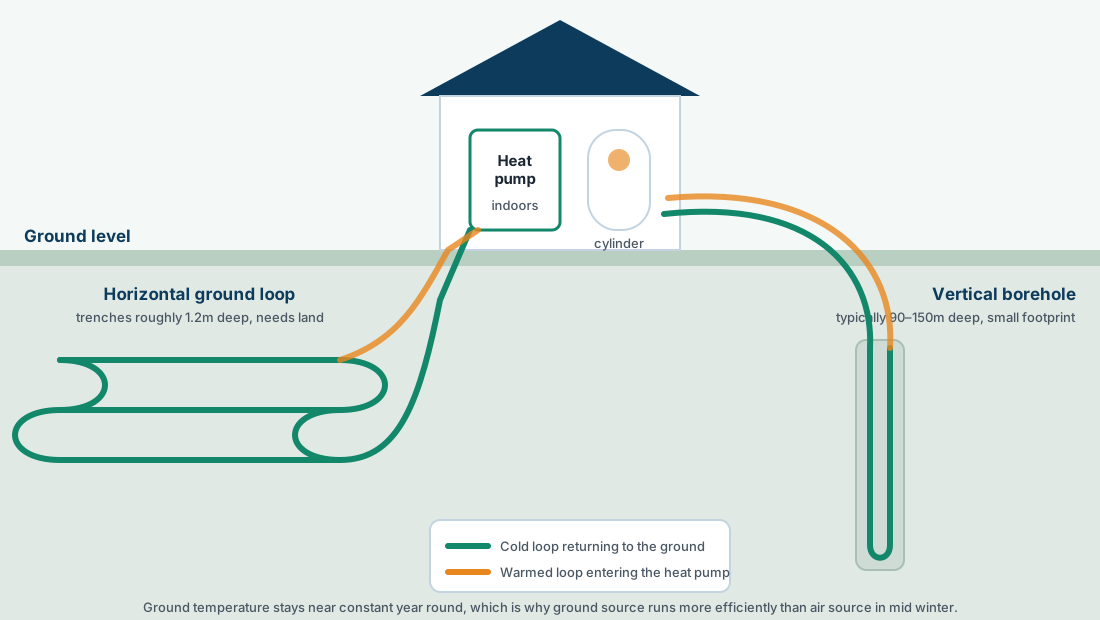
Horizontal ground loops sit in trenches around 1.2m deep. They are much cheaper than drilling, but they need land: as a rough guide, two to three times the floor area of the house. Plenty of properties around Langton Green, Hildenborough, Sevenoaks and the Weald villages have it. The garden is disturbed during installation and reinstated afterwards.
Boreholes are drilled vertically, typically 90 to 150m deep, and take up almost no surface area. They cost more because of the drilling rig and the geology, but they suit properties without the land and generally give slightly better performance. Around here the Wealden clay and greensand geology is workable but does affect the drilling rate, and therefore the price.
Horizontal loop systems typically run £20,000 to £28,000 before grant. Borehole systems run £25,000 to £35,000 and upwards depending on depth and how many are needed. The Boiler Upgrade Scheme pays £7,500 towards either, exactly as for air source, and that includes water source and shared ground loop arrangements.
The honest position is that ground source rarely pays back against air source on cost alone for an average house, because the grant is the same amount for a much more expensive installation. It makes sense where you have the land, where you are heating a large property, where running cost over decades matters more than capital cost, or where an outdoor unit would be unacceptable visually or on noise.
Trenching needs machine access to the garden. Drilling needs a rig with roughly three metres of headroom and a route in. We assess both at survey, because access is the single most common reason a ground source scheme turns out not to be viable on a site that otherwise looks ideal.
For horizontal loops, roughly two to three times the heated floor area of the property, in ground that can be trenched and reinstated. If you do not have that, boreholes need very little surface area but cost more to install.
Typically 90 to 150m. Larger properties sometimes need more than one. Depth is determined by the heat load and the thermal conductivity of the ground, which we establish before drilling rather than after.
Yes, usually noticeably so. Ground source commonly achieves a seasonal efficiency of 4 or better against 3 to 3.5 for air source, and the gap widens in cold weather. The trade-off is a much higher installation cost for the same grant.
Yes. The Boiler Upgrade Scheme pays £7,500 towards a ground source heat pump, the same as air source, and that covers water source heat pumps and shared ground loops too.
It will be disturbed and then reinstated. Trenching is invasive while it happens, and lawns take a season to recover fully. Boreholes are far less disruptive to the surface, which is often the deciding factor for an established garden.
The standard choice for most homes in Tunbridge Wells. An outdoor unit takes heat from the air and feeds your radiators, underfloor heating and hot water.
Air sourceBuried ground loops or boreholes give the highest efficiency and the lowest running costs, where you have the land for it.
Ground sourceWarm air straight into the room, and cooling in summer. No hot water, but the cheapest way in and now grant eligible.
Air to airOffices, retail, care homes, schools and light industrial premises, designed around real building loads and run hours.
CommercialWhat installation actually costs in this area, and what the Boiler Upgrade Scheme takes off the price before you pay.
CostsSurvey, design, grant application, installation and commissioning, with realistic timescales and disruption explained.
ProcessGet a free, no-obligation quote for heat pump installation in Tunbridge Wells, with the grant deducted so you see the real figure. We come back to you the same working day.